 Pascal Jobst

BEYOND ESSENTIALS
-
Core insight: Global SAP rollouts follow one of three delivery models – centralized, roll-in, or global – and each trades speed against durability differently.
-
Consequence: The wrong model rarely stops a project. It shows up later as rework, delay, or a template your subsidiaries work around.
-
Mid-market angle: With less budget to absorb a wrong turn, a mid-market company benefits more than most from choosing deliberately instead of defaulting to whichever model the first partner conversation happened to assume.
Global SAP projects don't follow a single playbook. The right delivery model depends on your organizational structure, how mature your subsidiaries are, and how much process standardization you're prepared to commit to upfront. Our Mid-Market Playbook for Global SAP Transformations describes the three approaches that come up in practice.
The terms vary from source to source. SAP's implementation guidance describes a template project followed by rollout projects, and many guides call that a global template rollout. In this article, centralized means the headquarters-first version of that approach, roll-in means starting in one smaller subsidiary, and global means designing with every major market at once. Whichever you choose, template scope and wave sequence decide most of the timeline.
DOWNLOAD THE FULL MID-MARKET PLAYBOOK HERE →
Three delivery models, three different trade-offs
Each approach trades speed against durability in its own way. The fit depends on your subsidiaries, your budget shape, and how much upfront alignment you can commit to.
1. Centralized rollout: design once, deploy in waves
The centralized rollout starts with the global template being designed at headquarters and implemented there first. It is then rolled out to subsidiaries in waves, prioritized by market size or strategic importance. Local resources handle localization; the global team covers the rest. It has a longer start and shorter rollouts once the template is proven, and it's resource-heavy upfront.
For a mid-market company, this model concentrates cost early, when the template still has to be built and validated, and spreads it out afterward as rollouts repeat the same pattern.
2. Roll-in approach: start small, expand outward
The roll-in approach inverts the centralized model. Implementation begins in a smaller, lower-risk subsidiary, and the template built there expands outward from that first market. It limits early exposure – a mistake in the first market is cheaper to fix than one baked into a template pushed to every subsidiary at once. The trade-off is a slower path to full global consistency.
For a mid-market company wary of committing its whole global budget before the design is proven, this is often the lower-risk entry point.
3. Global approach: every market at the table from day one
The global approach involves all major markets and consulting resources from the design phase itself. Template decisions get built together, with local knowledge informing global standards from the start. It's the most resource-intensive of the three models, and it tends to produce the most durable result.
For a mid-market company that can commit the upfront resourcing, this model reduces the rework that shows up later in the other two, since local realities are designed in from the start.
How the three models compare
All three models run through the same two phases: template design first, then rollouts to further markets. They differ in how long each phase takes and where the resources go.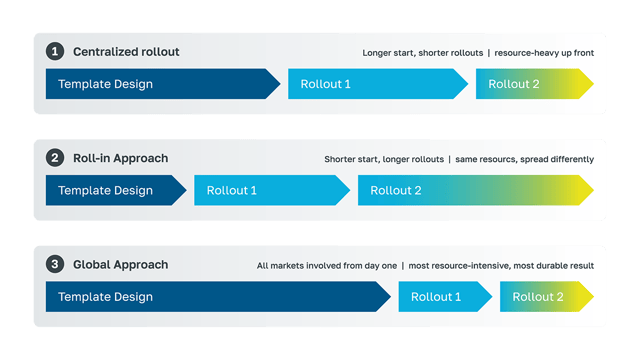
-
Centralized rollout: The centralized model has a longer start and shorter rollouts. Most resources go into the template design at headquarters, so the model is resource-heavy upfront. Once the template is proven, each rollout repeats the same pattern and moves faster.
-
Roll-in approach: The roll-in model reverses that shape, with a shorter start and longer rollouts. It uses the same resources as the centralized model, spread differently: less goes into the first design, and more goes into each rollout as the template expands outward from the first market.
-
Global approach: The global model involves all markets from day one, which gives it the longest design phase of the three. It is the most resource-intensive model, and it tends to produce the most durable result. The rollouts that follow are shorter, since local requirements are already built into the template.
Which model fits your company?
Four questions settle most of the decision. Answer them before you choose a delivery partner, since the model shapes what you need from one.
-
How much does headquarters control? If headquarters already sets processes for the subsidiaries, a centralized rollout builds on that control. If subsidiaries run largely on their own, a template designed without them will meet resistance in every wave.
-
How mature are your subsidiaries? A smaller, well-run subsidiary is a good test bed for a roll-in. It lets you prove the global template and your fit-to-standard decisions in one market before the larger ones follow.
-
How far apart are your processes and regulations? The more your markets diverge, the more a global approach pays for itself. Localization gaps found in design cost less than gaps found market by market during rollout.
-
What shape is your budget? If you can concentrate spend early, a centralized or global approach works. If each step has to prove itself before the next is funded, a roll-in matches that budget rhythm.
How one life sciences company got one team from day one
In a recent global transformation for a life sciences company with operations across North America, Europe, and Asia Pacific, the lead member made an early call: the customer needed to see one team from day one. Members from three regions came together before the first customer site visit, aligned on messaging, roles, and responsibilities, then walked into meetings in Romania, Switzerland, and the United States with one consistent position.
Michael Greene, Principal at Answerthink, described how that alignment happened: "We engaged Red Point and All for One early on, before we went into a customer environment. We made sure we understood what the issues and challenges were. We understood the roles and responsibilities of each member so that we could communicate a single message."
Local UNITED VARS members joined the site visits and immediately addressed region-specific concerns – statutory requirements, local business practices, and cultural expectations. The customer heard a consistent message from every geography, which reduced their perceived risk. An additional e-commerce opportunity surfaced during the ERP evaluation itself. It was addressed quickly by bringing in Knack Systems, a specialized UNITED VARS member for customer experience, without adding a separate vendor relationship to manage.
Michael Greene described what made the difference: the collective message and the ability to come together as one team under a single banner were "the value-add that ultimately led us to win the deal."
For a mid-market company, this means one aligned team across three regions and a new requirement covered mid-evaluation – with one relationship to manage instead of several separate vendor contracts.
Bring local expertise in before the design locks
The program that resulted runs on a simple guiding principle: one global ERP, one e-commerce platform, unified data. That clarity was possible because the member team aligned before the first customer conversation. The same holds for every delivery model. Centralized, roll-in, or global – local expertise pays off most when it joins while the design is still open.
Where UNITED VARS fits
Across all three approaches, one variable stays constant: genuine local expertise at every relevant point. Members in each market already know the statutory requirements, the business culture, and the people on the ground. That expertise supports a centralized, roll-in, or global model equally, so the model can follow your company's needs. How the alliance delivers for the mid-market explains the mechanics, and our global SAP support reference shows it in a live customer setting. More projects are collected in our references.
The full Mid-Market Playbook covers all three models in depth, with the governance and member perspectives behind them.
Planning a multi-country rollout and not sure which model fits? Talk to us.
Mid-sized companies should go global without losing speed or local identity. UNITED VARS brings together hand-picked local market leaders with real people on the ground in 100+ countries to remove legal, cultural, and language barriers. As a strategic alliance, UNITED VARS provides clear accountability from start to finish. UNITED VARS is the world's only SAP Platinum Partner alliance, delivering end-to-end SAP services for the mid-market.
stronger than one.
FAQ
Which SAP rollout model is cheapest for a mid-market company: centralized, roll-in, or global?
Centralized and roll-in models are both cheaper to start than the global approach, since they don't require consulting resources from every market at once. The global approach costs more upfront but tends to produce the result that survives contact with your actual subsidiaries, which can lower total cost over the life of the project.
What should a mid-market company decide before starting a global SAP rollout?
Four things: how much control headquarters keeps over processes, how mature and similar the subsidiaries are, how much standardization the company commits to before design starts, and whether budget can be spent upfront or must follow proof. Those answers point to a rollout model – centralized, roll-in, or global – which then shapes the global template, the wave plan, and the partner setup.
Who handles country-specific statutory and tax requirements in a global SAP rollout?
Local specialists in each country. Statutory reporting and tax rules differ by market and change often, so the rollout team needs people who work with them every day. In a UNITED VARS rollout, members in each market cover their country's statutory and tax requirements, while one lead member stays accountable for the global template and the overall plan.
Can you switch delivery models partway through a global SAP rollout?
It's possible but expensive. A template designed centrally and pushed outward assumes a different sequence of decisions than one built with every market at the table from day one. Switching models mid-project usually means revisiting decisions that were already made under the old model's assumptions.
What's the biggest risk in a global SAP rollout regardless of which delivery model you choose?
Bringing local expertise in once the design is already set. Whether the model is centralized, roll-in, or global, statutory and cultural gaps then surface during rollout, when fixing them costs more. A customer also notices when the delivery team presents one consistent message from the start, compared with a team assembling that consistency under pressure once problems appear.